Asked for a local showroom, the map still beats the chatbot
A large new study tested how often AI assistants name a particular local business. Google Maps did it twice as often. The detail of what the assistants quote is the useful part.
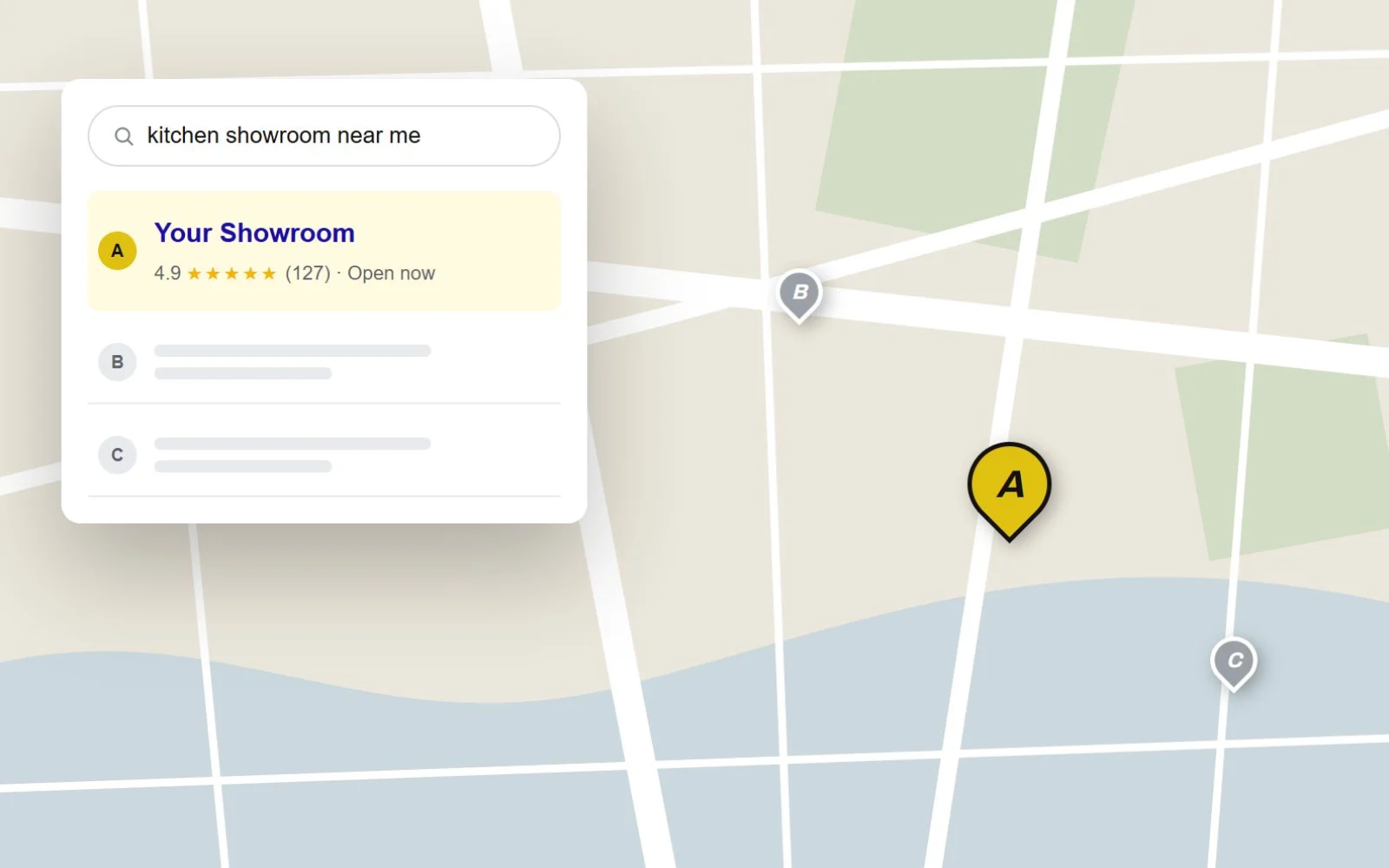
There has been a great deal of noise this year about AI replacing search. For a local business the more useful question is narrower: when somebody asks for a showroom near them, who actually gets named?
BrightLocal, which studies local search for a living, published the biggest test we have seen last month. It ran around 200,000 questions about roughly 1,300 business locations through Google Maps and through three AI tools.
The short version
- Google Maps named the business being tracked in about two thirds of searches. The AI tools managed about one third.
- Ask an AI the same question twice and you often get a different list.
- When AI tools do cite a source, it is mostly the business’s own website and its Google profile.
What the study found
66%How often Google Maps named the tracked business in BrightLocal’s test. For ChatGPT and Google’s two AI search features the figure was between 32 and 38 per cent.
Two more findings stood out. First, the AI answers were not stable. When the same question was run again, only 20 to 33 per cent of the businesses named were the same. Second, when the tools showed where their information came from, business websites accounted for 42 per cent of the citations and Google Business Profiles for nearly 29 per cent.
A caution: the study does not say which country its sample came from, so treat the exact numbers as a guide, not gospel.
What it means
The map is still the main event. For “near me” searches, the map and its three listings remain the most reliable way to be found. Anyone who tells you to drop local search for “AI optimisation” has it backwards.
You cannot rank in a chatbot. If the answer changes each time, there is no position one to win. What you can do is be consistently eligible: well described, well reviewed, easy to verify.
You write most of what AI says about you. Seven in ten citations in that study came from two places the business itself controls. That is remarkable. It means the description an assistant gives of your showroom is largely built from your own words.
Seven in ten of the sources AI tools cited were the business’s own website or its Google profile. You are writing your own reference.
One thing that quietly disappeared
Google has retired the public question-and-answer section on business profiles, replacing it with an AI “Ask” button that answers from whatever it can find. If you ever used that section to explain parking, appointments or whether you fit what you sell, those answers now need to live somewhere the AI can read them: in your profile description, your services list and, above all, your website.
A short list for this month
- Fill in every field of your Google Business Profile: services, areas, products, attributes, hours.
- Write a proper description in full sentences, saying what you do, for whom and where.
- Add an FAQ page to your website answering the ten questions you are asked most.
- Keep facts identical everywhere your business is listed.
- Post and add photographs regularly. A profile that is visibly alive gives every system more to work with.
Our view
The fashionable advice this year has been to chase AI. The evidence says do the unfashionable things well: a complete, active Google profile and a website written in plain, factual English. Those two win the map today and feed the assistants tomorrow. It is the same work either way, and it is work that has to be kept up, which is why we do it for our clients as a routine, not a project.
Sources: BrightLocal, “Local AI Visibility Study” (16 September 2026), brightlocal.com; Search Engine Roundtable, report on the removal of Q&A from Google Maps (15 December 2025), seroundtable.com.