The rules on reviews have changed twice in six weeks
Google has tightened what you may ask a customer, and the competition regulator has opened its first fake-review investigations. Some very common showroom habits are now on the wrong side of the line.
Reviews are the most valuable marketing most showrooms own, and the rules around them have shifted twice since February. Neither change was aimed at our industry. Both catch habits we see in it all the time.
The short version
- Google now bans rewards for any review, asking only happy customers, and pressing people to review while they are still in the showroom.
- The Competition and Markets Authority has started investigating businesses over misleading reviews, with fines of up to 10 per cent of turnover available.
- The safe approach is also the best one: ask everybody, afterwards, with no strings.
What Google changed
In February Google’s review policy for business profiles was reported with new, sharper wording. It rules out offering anything “in exchange for posting any review”. It rules out selectively asking customers you expect to be positive. It rules out pressuring customers to leave a review while on the premises, and asking them to include particular content. It also says Google will look for unusual volumes or patterns.
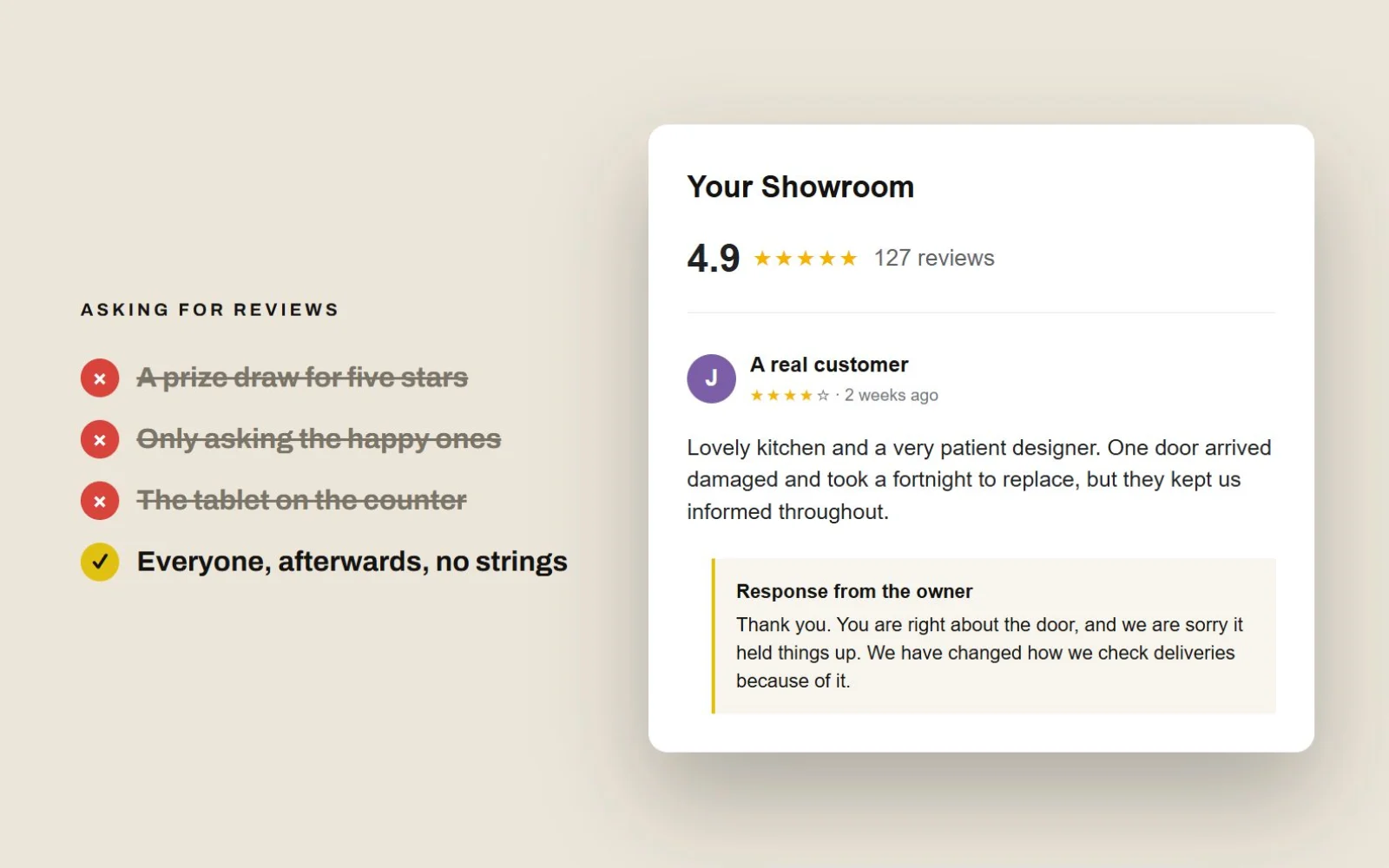
Read that list again with a showroom in mind. The prize draw for anyone who leaves five stars. The tablet on the counter on handover day. The email that goes only to the customers who seemed delighted. All of them are now explicitly against the rules.
What the regulator did
Fake and misleading reviews have been against consumer law since April 2025. On 27 March the Competition and Markets Authority opened its first five investigations under those powers. The cases involve Autotrader and Feefo over one-star reviews being left out, a funeral provider over reviews written by staff, Just Eat over inflated ratings, and a food company over undisclosed discounts in return for five-star reviews. A sweep of more than a hundred businesses that publish reviews produced 54 advisory letters.
None of these is a kitchen or bathroom retailer, and no findings have been made. The point is the pattern. Hiding the bad ones, writing your own and paying for good ones are precisely what the regulator has gone after first.
The prize draw for five stars, the tablet on the counter, the email only to happy customers. All three are now against the rules.
A review routine that is safe and works
- Ask every customer. Not the ones you think will be kind. Everyone.
- Ask after the job, by email or text, with a direct link. They write it at home, in their own time.
- Offer nothing. No vouchers, no draws, no discount on the next purchase.
- Do not script it. Never suggest wording or ask them to name a member of staff.
- Reply to all of them, including the awkward ones, in a human voice. A calm answer to a three-star review sells better than ten five-star ones.
- Never remove, hide or bury a genuine review on your own website.
Our view
We like these changes. A steady trickle of honest reviews from every customer, each with a reply, is worth far more than a burst of suspiciously perfect ones, and it is exactly what Google is now built to reward. It is also dull, regular work that never gets done in a busy showroom, which is why we do it for our clients as part of looking after their Google profile every month.
Sources: Search Engine Roundtable, “Google Business Profile review policies updated” (February 2026), seroundtable.com; Competition and Markets Authority, “Fake and misleading reviews: 5 businesses under CMA investigation” (27 March 2026), gov.uk. This article is general information, not legal advice.