ChatGPT now carries adverts in the UK. Should a showroom care?
Adverts appeared inside ChatGPT for British users on 6 June. It is tempting to rush in or to shrug. Both are the wrong reaction.
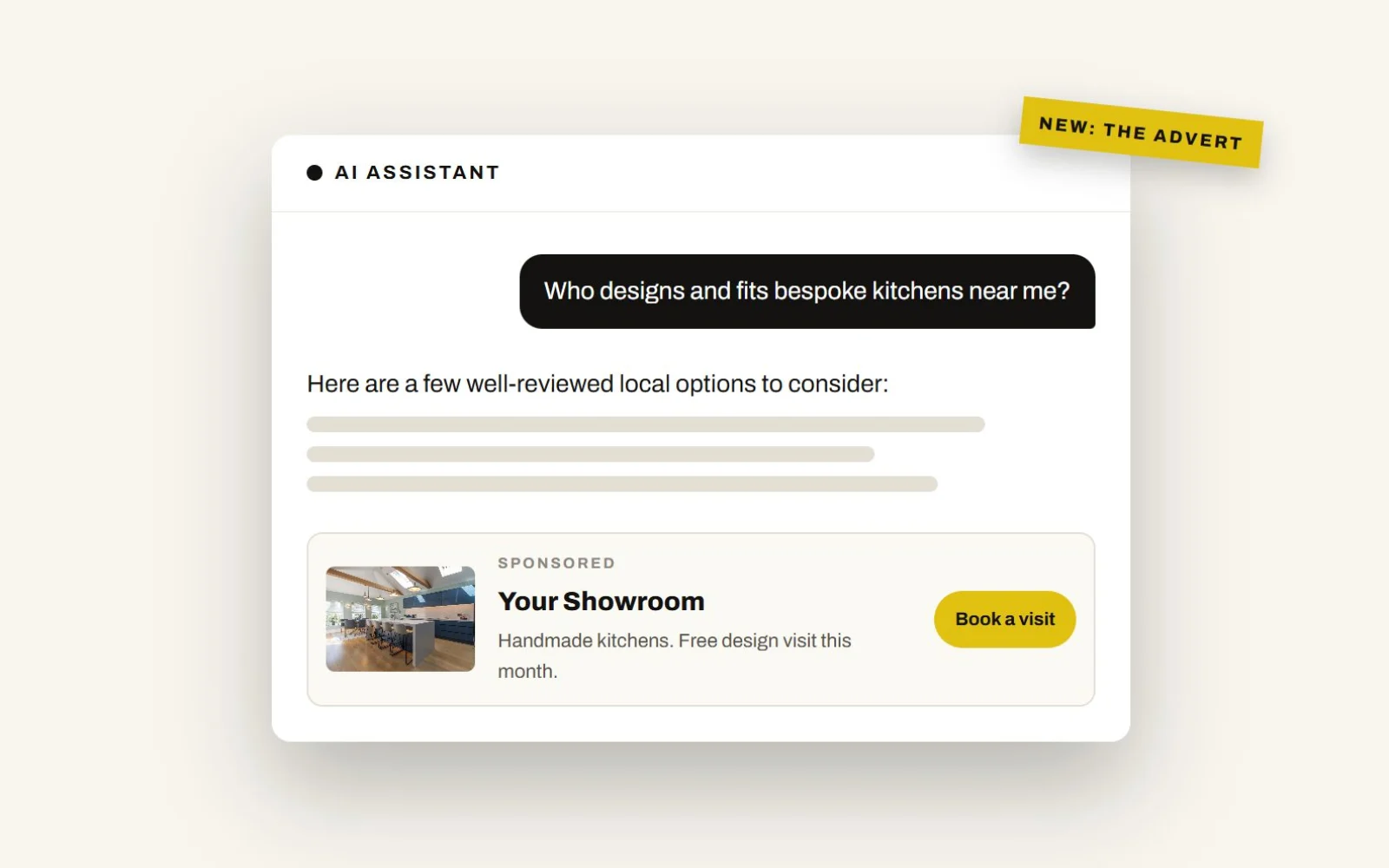
On 6 June adverts went live inside ChatGPT in the UK, the first European market to get them. They appear for people on the free and lower-priced plans. For now there is no simple way for a small British business to buy them directly.
It is a fair question to ask whether a showroom should be doing anything about it, so here is where we stand.
The short version
- Do not spend money on it yet. You cannot easily buy it, and nobody knows what works.
- Do take the hint. People asking an AI assistant for a recommendation is now normal behaviour.
- The job today is to be the business the assistant names without being paid to.
How normal is this now?
More normal than most people in our trade assume. Kantar surveyed more than two thousand people in the UK at the start of this year. It found 43 per cent already use AI tools to learn about products and services, compare prices or make enquiries. One in four had asked an AI for a product recommendation.
15%of people in Kantar’s UK survey said that if an AI did not suggest a brand, they would assume it was not for them.
That last number is the one to think about. It is not that the assistant sends you less traffic. It is that, for a growing slice of buyers, a business the assistant does not mention has stopped existing.
Why we are not rushing to buy the adverts
New advertising space always follows the same course. The early months are expensive experiments run by large brands with budgets to burn. The formats change every few weeks. The reporting is thin. Then, if it works, it becomes available to everyone, the prices settle and the lessons are known.
A showroom spending a few hundred pounds a month should not be paying for anyone’s experiment. Paid search and Facebook and Instagram are proven, measurable and nowhere near exhausted for most independents.
What to do instead
An assistant recommends businesses it can read, check and quote. All three are within your control today, and none of them costs advertising money.
- Read. Your services, areas, prices from, opening hours and process should be written out in plain sentences on your website, not hidden inside images or a downloadable PDF.
- Check. Your name, address, phone number and hours should be identical on your site, your Google profile and every directory. Assistants compare.
- Quote. Pages that answer real questions (“how long does a kitchen take to fit?”, “what does a wet room cost?”) in a couple of clear sentences are what gets lifted into an answer.
- Prove. Recent, genuine reviews with replies are evidence an assistant can cite.
The aim is not to buy a mention. It is to be the name the assistant gives when nobody has paid it anything.
Our view
We will tell you when a new platform is worth your money, and this one is not there yet. It sits firmly in our “watch” column. But the behaviour behind it is real and growing, which is why everything we build is made to be read by machines as well as people. Get that right and you are ready for the adverts when they do make sense, and visible in the meantime for nothing.
Sources: PPC Land, “ChatGPT ads go live in the UK” (June 2026), ppc.land; Research Live, “Generative AI changing shopping trends, finds Kantar” (31 March 2026), research-live.com.