Cookie banners: simpler rules, bigger fines
New data law is coming into force in stages this year. It loosens the rules for harmless visitor counting and raises the stakes for getting advertising cookies wrong. Most showroom websites need ten minutes of attention.
Nobody opens a showroom to think about cookies. But your website almost certainly sets them, the law around them is changing this year, and the regulator has become noticeably more active. Here is what matters, without the jargon.
The short version
- Counting visitors no longer always needs a consent pop-up, provided the tool does nothing else.
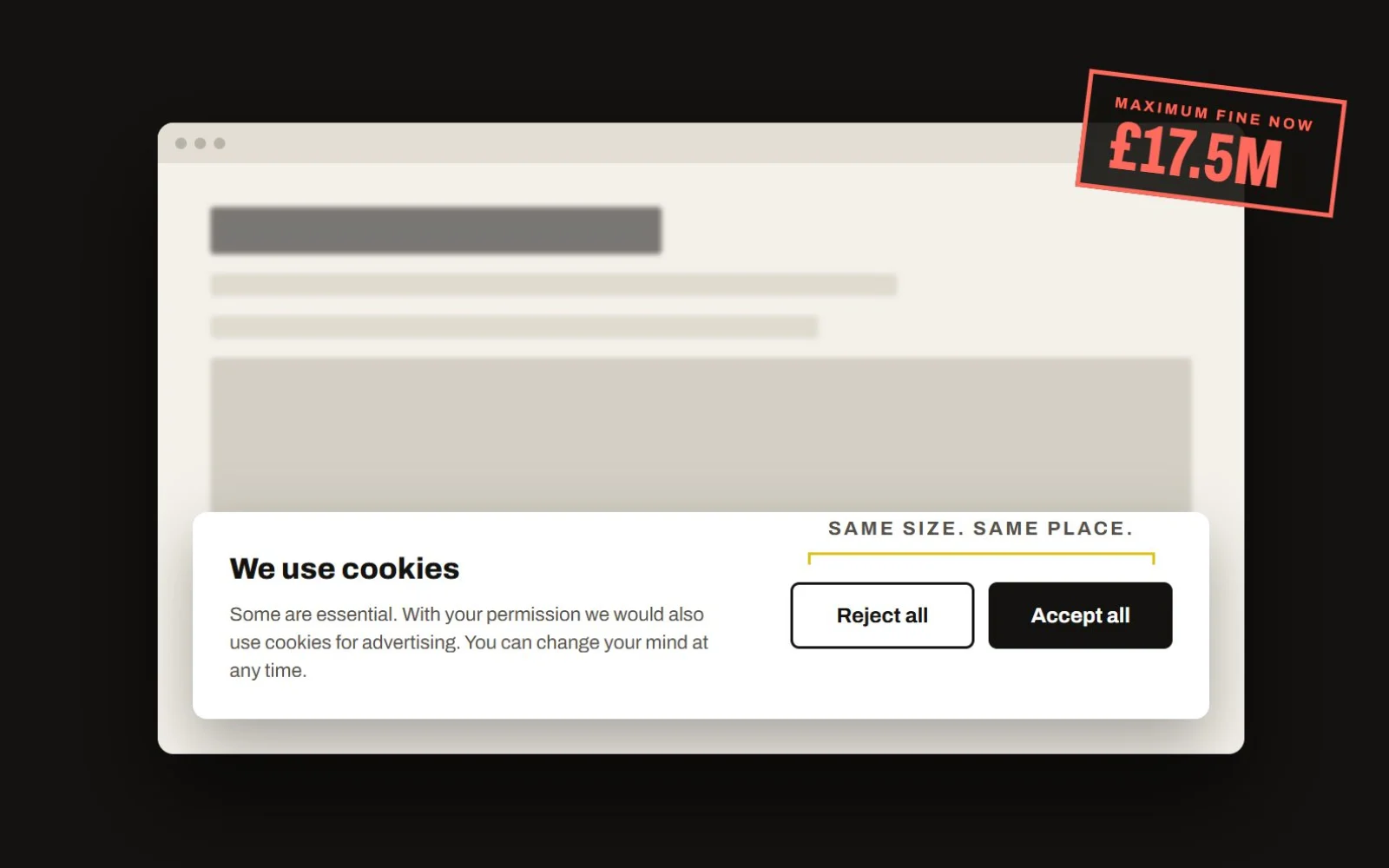
- Advertising and tracking cookies still need a clear yes first, and “reject” must be as easy as “accept”.
- The maximum penalty for getting it wrong has risen sharply. Small sites are unlikely targets, but an untidy banner is an easy thing to fix.
What has changed
The Data (Use and Access) Act became law last year and its provisions have been arriving in stages through 2026. Two parts affect an ordinary business website.
First, there are new exceptions to the consent rule. Cookies used only to count visitors and see how the site is used, and cookies that only remember how someone likes the site to look, can now be set without asking, as long as visitors are told and given a simple, free way to opt out. The Information Commissioner’s Office published its final guidance on this at the end of April.
There is a catch that will trip up a lot of sites. The exception does not apply if the same tool also feeds advertising. If your visitor statistics are linked to your ad accounts, as they very often are, you still need consent.
Second, the ceiling on fines under the marketing and cookie rules has gone from £500,000 to the same level as data protection law generally: up to £17.5 million or 4 per cent of turnover.
Is the regulator really looking?
Yes, though not at you in particular. In December the ICO reported on its review of the UK’s thousand most-visited websites. It said 979 of them now met its two basic tests: no advertising cookies before the visitor agrees, and a “reject” option as easy to use as “accept”.
A local showroom is not in the top thousand. But those two tests are now the standard everyone is measured against, and a customer who notices a sneaky banner draws their own conclusions about how you do business.
A buyer who has to hunt for the “reject” button has learned something about you before they have seen a single kitchen.
Ten minutes on your own site
- Open the site in a private window. Does a banner appear? Is “reject” a button, the same size as “accept”, on the first screen?
- Press reject and look around. Does the site still work? It should.
- Ask whoever looks after the site which cookies are set before consent. The honest answer should be “only essential ones”.
- Check what your statistics are connected to. If they share data with advertising, treat them as advertising cookies.
- Read your own cookie page. If it mentions tools you stopped using years ago, it needs rewriting.
Our view
This is dull, and it matters. Not because an inspector will knock, but because a clean, honest banner is a small piece of the trust you are asking for with a five-figure deposit. It is how we set up the sites we build. If you are not sure what yours is doing, ask whoever built it. If they cannot tell you, that is an answer in itself.
Sources: Information Commissioner’s Office, “ICO action secures increased cookie compliance” (4 December 2025), ico.org.uk; Womble Bond Dickinson, “New exceptions for non-intrusive cookies: the ICO’s updated guidance”, womblebonddickinson.com. This article is general information, not legal advice.