Google may have just changed how your search adverts work
This month Google has been moving many search campaigns onto a new AI-driven setting called AI Max. If nobody has looked at your account since August, it may now be spending your budget on searches you never chose.
If you pay for adverts on Google and have not looked inside the account for a few weeks, please look this week. Something may have changed without anyone pressing a button.
The short version
- Through September, Google has been upgrading many search campaigns to a setting called AI Max.
- AI Max lets Google match your adverts to a wider range of searches and adjust the wording itself.
- That can find good customers you were missing. Left unwatched, it can also spend your money on the wrong ones.
What Google has done
Google announced in the spring that search campaigns using certain automated features would be upgraded to AI Max, starting in September 2026 and finishing by the end of the month. Specifically, it covers campaigns that use automatically created assets or the campaign-level broad match setting. Campaigns built on Dynamic Search Ads follow in February.
Under AI Max, search term matching is switched on by default. Put simply, Google decides which searches are relevant to you, going beyond the keywords you typed in, and can tailor the advert’s text to the search.
To its credit, Google has improved the reporting alongside it. A new view shows the search someone typed, the advert they were shown and the page they landed on, together in one place.
Why this cuts both ways
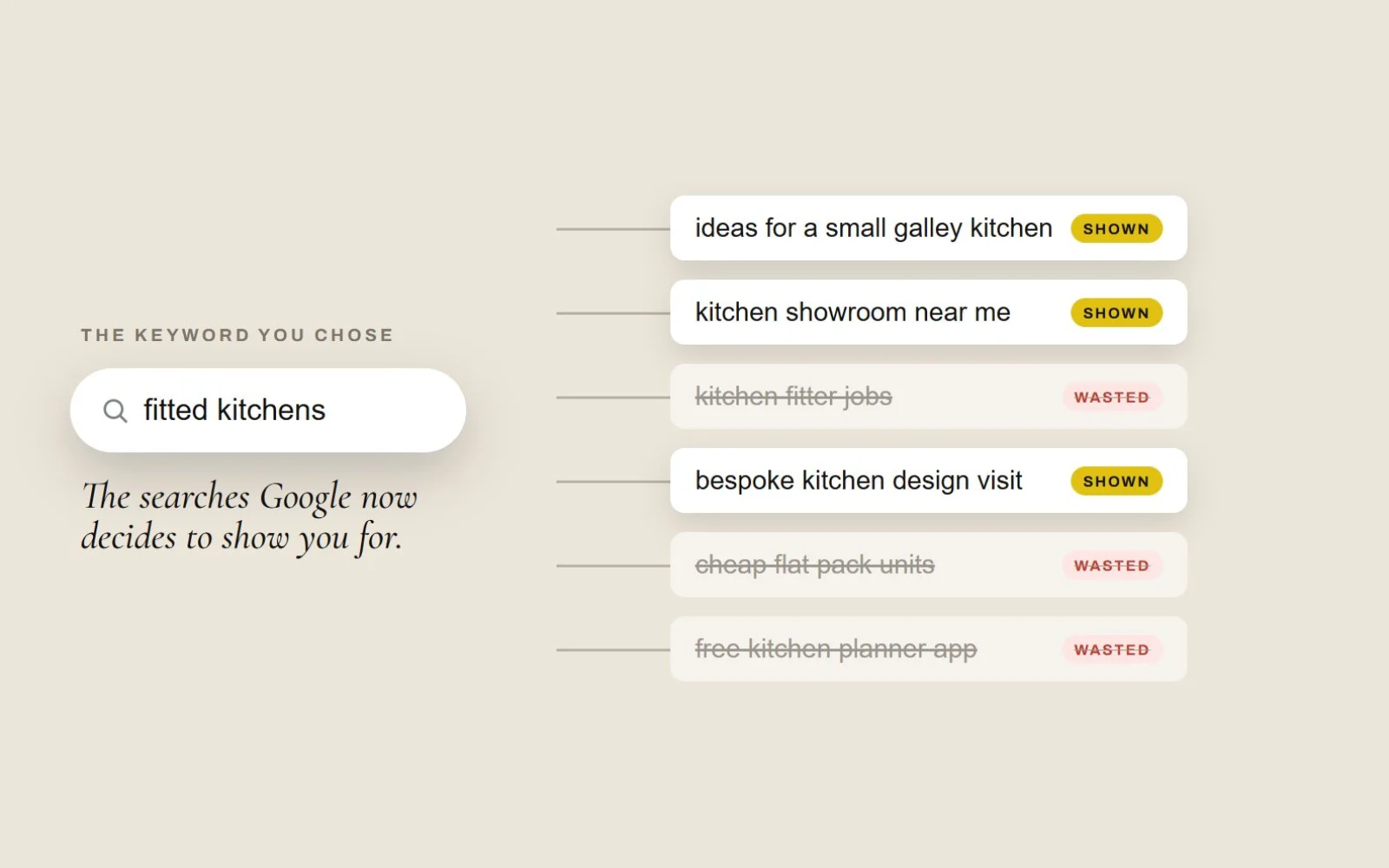
Nobody can list every phrase a homeowner might type. A system that spots “ideas for a small galley kitchen” as a likely buyer, when you only bid on “fitted kitchens”, is doing something useful.
The trouble is that the same system does not know your business. It does not know you only fit within fifteen miles, that you do not sell flat-pack, that you have never done a commercial job, or that a search for “kitchen fitter jobs” is someone looking for work. Left alone, it will happily spend your budget finding out.
The machine is very good at finding people. It has no idea which of them you actually want through the door.
Five checks to make this week
- See whether you have been moved. Open each search campaign’s settings and look for AI Max.
- Read the search terms report for the last thirty days. Every phrase you would not want to pay for goes on the blocked list.
- Check where clicks are landing. The system can choose the page. Make sure it is choosing ones that ask for a design visit, not your privacy policy.
- Read the adverts Google has written. If it is promising things you do not offer, turn text customisation off.
- Look at cost per enquiry, not clicks. If enquiries are flat and spend is up, the wider matching is not earning its keep.
Should you switch it off?
Not necessarily. Wider matching, with a firm blocked list and proper tracking of real enquiries behind it, can find buyers the old setup missed. The mistake is not using it. The mistake is using it and walking away.
Our view
Every year the advertising platforms take a little more of the steering wheel, and every year the value of someone checking the account weekly goes up, not down. A small retailer cannot afford a month of the wrong clicks. This is exactly the sort of quiet change that costs showrooms money without anybody noticing, and exactly why we read the search terms every week.
Sources: Google, “Upgrading to AI Max for Search campaigns” (15 April 2026, updated June 2026), blog.google; Google, “New AI Max reporting features” (23 September 2026), blog.google.